
Club author
Clubs · Jun 8, 2026 · 3 min read
Save
Share
Keep reading
authenticated by

Clubs · Jun 8, 2026 · 3 min read
Save
Share
Keep reading
iGuide Stories
Global climate change is an urgent issue affecting every aspect of life on Earth. Climate change not only causes extreme weather events but also threatens biodiversity, alters ecosystems, and severely impacts human health. Additionally, the global economy is heavily affected as industries, agriculture, and services reliant on climate conditions face new challenges.
What is global climate change and the impact of global climate change?
According to Clause 13, Article 3 of the 2015 Law on Hydrometeorology regulations on climate change are as follows:
“13. Climate change is a change in climate over a long period of time due to the impact of natural conditions and human activities, manifested by global warming, sea level rise and rising sea levels. increase in extreme hydro-meteorological phenomena”.
Accordingly, it can be understood that global climate change (or simply called climate change) is a term used to refer to changes in climate due mainly to human impacts that change components. of the earth's atmosphere.
This change combined with natural fluctuating factors leads to changes in climate over time. To put it simply, global climate change is the change of the climate system from the biosphere, atmosphere, hydrosphere to lithosphere in the present and the future.
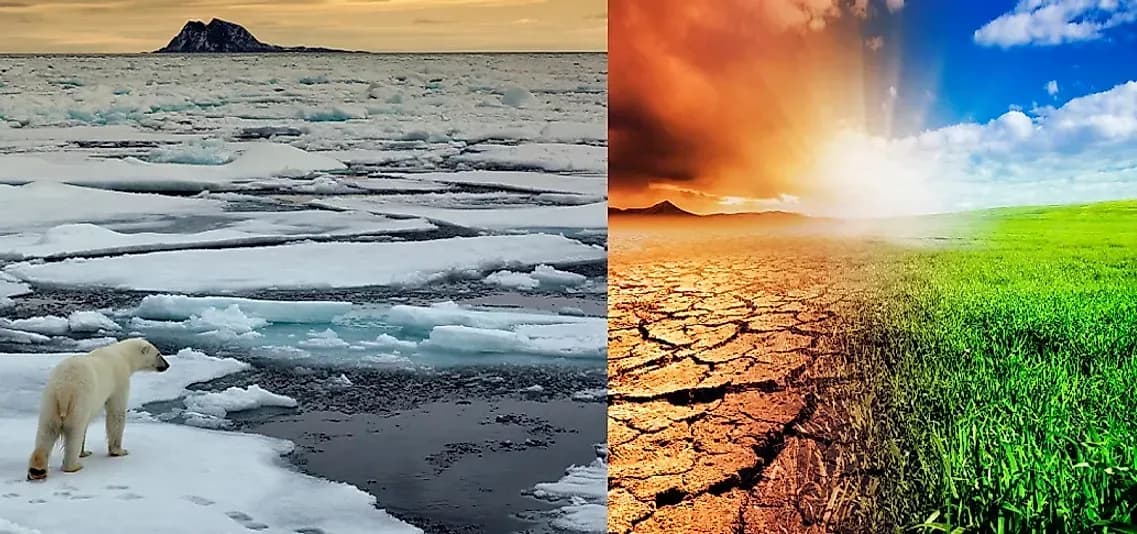
Temperatures are getting higher and higher on earth, causing sea levels to gradually rise. Rising temperatures cause glaciers, sea ice or ice continents on Earth to melt and increase the amount of water flowing into the seas and oceans.
Changes in climate conditions and rapid increases in carbon dioxide levels have seriously affected ecosystems, fresh water supplies, air, fuels, clean energy, food and health.
Under the influence of temperature, air and melting ice, the number of coral reefs tends to decrease. This shows that both terrestrial and aquatic ecosystems are suffering from impacts from floods, droughts, forest fires, as well as ocean acidification.
Current global temperatures are causing species to disappear or be at risk of extinction.
Humans are also not outside the scope of influence. Falling land and rising sea levels also threaten our habitat.
Food and fresh water are increasingly scarce, land is gradually disappearing but the population continues to increase; These are the factors that cause conflicts and wars between countries and territories.
According to analysis by experts, countries that often suffer from water scarcity and crop failures are often very unstable in terms of security.
Increasing temperatures combined with floods and droughts are becoming a threat to global population health. Because this is the ideal habitat for mosquitoes, parasites, rats and many other disease-carrying creatures to thrive.
While some parts of the world are inundated with constant floods, others are suffering from prolonged, severe droughts. Droughts deplete domestic and irrigation water sources, seriously affecting the agriculture of many countries. As a result, food production and supply are threatened, and a large number of the earth's population are and will suffer from hunger and thirst.
Warmer water temperatures in seas and oceans are a factor that strengthens storms. Severe storms are becoming more frequent.
Economic losses caused by climate change are also increasing with global temperature. Big storms cause crop failures; In addition, to control epidemics that spread after each storm and flood also requires a huge amount of money. The harsher the climate, the greater the deficit in economies.
Log in to leave a comment. Log in
Be the first to comment.
Curate
Sign in to curate
React to this story
